Posted by: davidlarkin | August 1, 2008

Perugino Presages Palmer

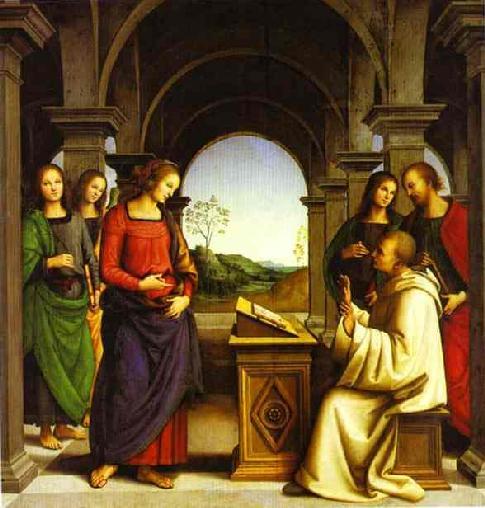
Perugino, an early Renaissance Florentine artist (1446-1523), was so popular he needed a workshop full of assistants to meet the demand for his commissions for altar-pieces. Renaissance painter of genius, Raphael (1483-1520), learned his craft in Perugino’s workshop.

In Perugino’s “The Vision of St. Bernard” (1490-94), the Virgin Mary and her three attending angels all share the same type of feminine beauty, especially facial, when appearing in St. Bernard’s vision.

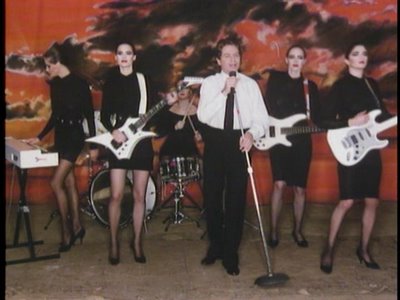
The Perugino use of similar visages for his Virgin and accompanying angels presages the vision of Robert Palmer in his 1989 music video Addicted to Love with the guitar-playing muses of similar beauty swaying behind him.

from Robert Palmer’s Addicted to Love Music Video

Posted by: davidlarkin | July 28, 2008

The Twenty Million Dollar Golden Calf

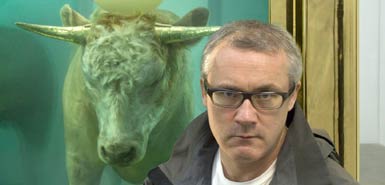
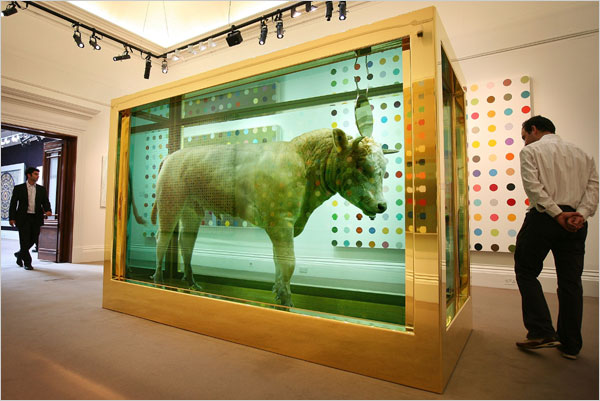
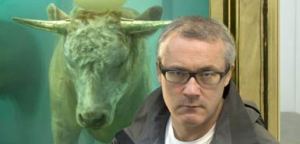
Damien Hirst’s latest creation — a bull submerged in formaldehyde, with a head crowned by a solid-gold disc, and hooves and horns cast in 18-karat gold — is expected to fetch $16 million to $24 million when it is sold at a Sotheby’s auction in London on Sept. 15. “The Golden Calf,” above, with the artist, will be part of a two-day auction of works made by Mr. Hirst in the last two years, Sotheby’s announced on Thursday. In addition to the bull, the auctions on Sept. 15 and 16 will include some of his new paintings, drawings and sculptures. This is the second time Sotheby’s has held an all-Hirst auction. In 2004 it sold the contents of the Pharmacy, his defunct Notting Hill restaurant, which included Hirst-designed ashtrays and bar stools, as well as his paintings, for $20 million. Last summer Mr. Hirst’s human skull cast in platinum and covered with 8,601 diamonds was said to have been sold to an investment group for $100 million.

New York Times, July 20, 2008.

The official offering of the Golden Calf with pictures is set forth in the Sothebys Press Release.

At the Sotheby’s auction in September 2008, the Golden Calf sold for $18.6 million.
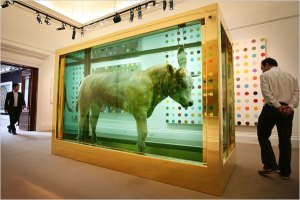
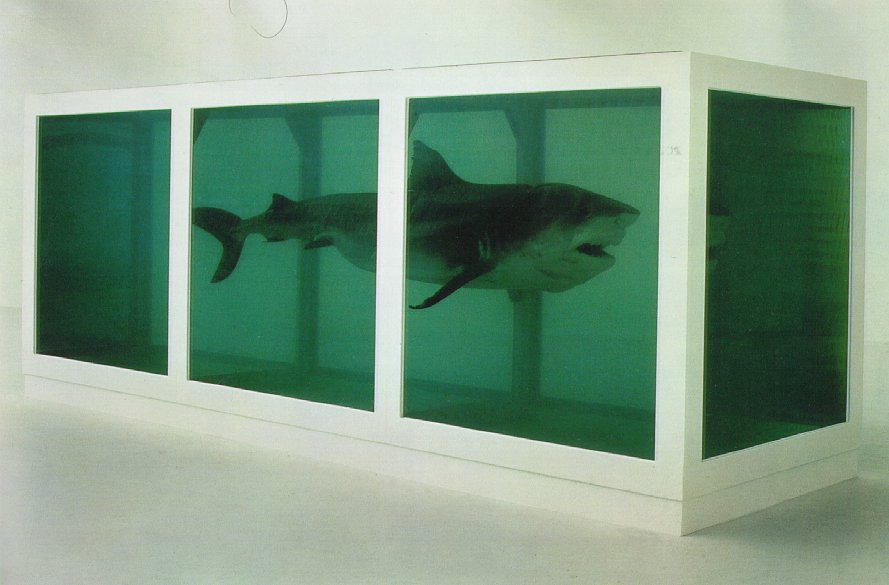
Hirst’s 2007 Shark in Formaldehyde resulted in a big pay day,
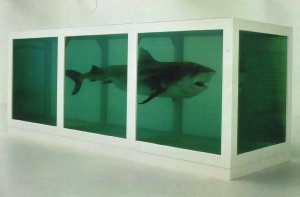
catching the attention of editorialists. In an editorial, The New York Times had this to say about his dead shark floating in formaldehyde, and what the high prices mean for art:

In August, the shark in formaldehyde — Damien Hirst’s signature work — will come to the Metropolitan Museum of Art, on loan from Steven A. Cohen, a hedge fund trader and art collector. Mr. Hirst’s shark, whose proper name is “The Physical Impossibility of Death in the Mind of Someone Living,” is usually called a piece of conceptual art. So when you go to visit the shark (actually the second to be entombed in this vitrine) it will be worth considering the entire scope of the conceptualism surrounding it.

First, you will have to shelve any objections you might have to the idea of killing a female tiger shark in the interests of Mr. Hirst’s career. You might even wonder whether the catching of the shark, somewhere off the coast of Australia, wasn’t in its own way more artful than the shark’s lamentable afterlife suspended in formaldehyde.

But the real concepts here are money and reputation. It may appear as if Mr. Cohen is doing the Met a favor by lending this work. In fact, it is the other way around. The billionaire, number 85 on the most recent Forbes 400 has been collecting art at a furious rate since 2000, and he is being courted by museums in the way that prodigiously wealthy collectors have always been courted. Part of that courtship is, of course, endorsing and validating the quality of the collector’s eye. The only defense against the skewing of the art market created by collecting on Mr. Cohen’s scale is to appropriate the collector himself.

The difference in this case is Mr. Hirst, who has gone from being an artist to being what you might call the manager of the hedge fund of Damien Hirst’s art. No artist has managed the escalation of prices for his own work quite as brilliantly as Mr. Hirst. That is the real concept in his conceptualism, which has culminated in his most recent artistic farce: a human skull encrusted in diamonds.

You may think you are looking at a dead shark in a tank, but what you’re really seeing is the convergence of two careers, the coming together of two masters in the art of the yield.

Art critics complain that the aesthetic choices and the high prices for this type of contemporary art cheapens art. The New Republic’s long-time art critic, Jed Perl, considers work like Hirst’s to be junk, art reduced to mere commercial product. He labels the declining standard as laissez-faire aesthetics in his article, Postcards from Nowhere:

. . . I find it interesting that many commentators are far more eager to criticize the collectors and the dealers than the art stars who produce this junk in the first place. Can it be that even the most vapid machine-tooled work is still covered by the old romantic alibi, namely that the muses made me do it? The woes of the art world cannot be blamed entirely on the rapacity of a cadre of collectors, dealers, and curators. After all, it was an artist, Damien Hirst, who dreamed up the platinum replica of a human skull, paved with diamonds, that was first exhibited last year in London in a show called “Beyond Belief.”

It is the artists, and a certain line of thinking about art, that have given the people with the cash permission to buy and sell what amounts to nothing, and to do so for ever larger and more insane sums of money. All this sensational commerce is fueled by the anti-aesthetics that were born nearly a century ago among the Dadaists, and have by now morphed into the laissez-faire aesthetics that give collectors sanction to regard one of Jeff Koons’s stainless-steel balloon animals as simultaneously a camp joke and a modern equivalent of a Tang dynasty horse. (A critic in The New York Times described one of these glistening metal doggies, currently on display on the roof of the Metropolitan Museum of Art, as a “masterpiece.”) The artists involved–beginning with Duchamp and including Rauschenberg, Warhol, Salle, and Koons–celebrate, or toy with, a number of apparently contradictory thoughts: that art is nothing; that art can be anything; that randomness and order are the same thing; that art has no particular place in the world; that art can be found anyplace in the world; that art is just another commercial product, like tennis balls and washing machines.

Postcards from Nowhere – Jed Perl – TNR.

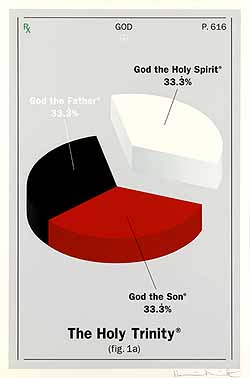
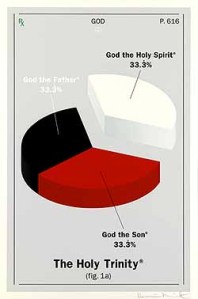
With The Golden Calf, surely tongue in cheek, Hirst chooses a reference from the Bible for his title, referring of course, to the idol created by Aaron for the children of Israel while Moses delayed on the Mount while God delivered the Ten Commandments to him. He is not afraid to comment on religion, and Christianity in particular, with his art. His 2007 show in a London Church was titled New Religion, and featured feet bleeding from nail wounds and this work titled The Holy Trinity, for example.
[More about Hirst at Artsy Damien Hirst Page]

When Hirst chooses to enter into the spiritual arena, he opens the door to spiritual interpretation. In The Brothers Kamarazov, Dostoyevski considers art as a spiritual battlefield:

Beauty! I can’t endure the thought that a man of lofty mind and heart begins with the ideal of the Madonna and ends with the ideal of Sodom. What’s still more awful is that a man with the ideal of Sodom in his soul does not renounce the ideal of the Madonna, and his heart may be on fire with that ideal, genuinely on fire, just as in his days of youth and innocence. Yes, man is broad, too broad, indeed. I’d have him narrower. The devil only knows what to make of it! What to the mind is shameful is beauty and nothing else to the heart. Is there beauty in Sodom? Believe me, that for the immense mass of mankind beauty is found in Sodom. Did you know that secret? The awful thing is that beauty is mysterious as well as terrible. God and the devil are fighting there and the battlefield is the heart of man.

Dostoyevsky, The Brothers Kamarazov

Even if you don’t believe in the devil, it is easy to make a claim that the devil is at work in art works, purposely devilish, who would inspire an artist to put a crucifix in a jar of urine, i.e., Piss Christ, the 1989 photograph by Andres Serano, or that otherwise make light of a religious icon or the Holy Trinity, as Hirst does.

Personally, I worry for the fate of the artist rather than suffer any injury from a work like this. There may be a relationship between death by natural causes and blasphemy or disrespect for the living God. But that would be a personal concern of the artist, not mine, other than my God-given charitable concern for the artist’s fate which leads to intercession and prayer rather than outrage.

I remember while waiting for a airline flight in Las Vegas back in the 80s, I noticed Sam Kinison was also waiting for the same flight. Kinison was a fundamentalist pentecostal preacher as a child, and, at the time we were waiting for the flight, his comedy act featured authentic blasphemy. I remember cringing at the sincerity of his blasphemy and worried that he might be struck by lightning right here on our stage. Some of his religious humor was actually funny, as when he imitated one of Jesus brothers complaining to the Virgin Mary “Stop asking me why I can’t be like my brother Jesus.” Nevertheless, waiting for the plane, I considered changing planes because I was afraid God might take Sam and the rest of us. Then, I noticed he was traveling with his mother and I had read, probably in Rolling Stone, that his mother still prayed for him. So, I decided that with his mother on board, the flight was likely a safe one. Despite the dearth of real evidence, the flight obviously made it to the destination. I have since heard from a client that claims to have sat in the audience at Sam’s shows with Sam’s mother, that Sam’s mother drank whiskey during the shows, laughing with the audience at his blasphemous comedy. Of course, she may have prayed the mornings after nursing a hangover.

I recently read that the Apostle John, the author of the Gospel of John and the Revelation in the Bible, had a similar experience. Eusebius writes in his History of the Church, Chapter XXVIII, about a time when entering a public bath, St. John saw Cerinthus, a notorious heretic and enemy of Christ, enjoying a bath and feared catastrophic collapse of the roof of the bath:

But Irenæus, in the first book of his work Against Heresies, gives some more abominable false doctrines of the same man, and in the third book relates a story which deserves to be recorded. He says, on the authority of Polycarp, that the apostle John once entered a bath to bathe; but, learning that Cerinthus was within, he sprang from the place and rushed out of the door, for he could not bear to remain under the same roof with him. And he advised those that were with him to do the same, saying, “Let us flee, lest the bath fall for Cerinthus, the enemy of the truth, is within.”

John also is the author of three epistles or letters in the New Testament. The first, referred to as 1 John, is a response to the gnostic heresy attributed to Cerinthus.

In April 1992, six days after Sam Kinison married his girlfriend Malika, he was killed when his white Pontiac Firebird Trans Am was struck on U.S. Route 95 four miles north of Interstate 40 and several miles west of Needles, California by a pickup truck driven by a 17-year-old who had been drinking. Kinison was 38. Kinison was later found to have cocaine, Valium, Xantac and codeine in his bloodstream. Sam Kinison’s last words when he was fatally injured in the automobile accident were in a conversation with someone who wanted Sam to go with him, and Sam objected, before giving in:

“He said, ‘I don’t want to die, I don’t want to die,'” recounted his best friend, Carl LaBove, who held Kinison’s bleeding head in his hands.

Kinison paused, as if listening to a voice that couldn’t be heard, LaBove said.

“But why?” asked Kinison, a former Pentecostal preacher. It sounded, LaBove said, as if “he was having a conversation, talking to somebody else. He was talking upstairs. Then I heard him go, ‘OK, OK, OK.”The last “OK” was so soft and at peace… whatever voice was talking to him gave him the right answer, and he just relaxed with it. He said it so sweet, like he was talking to someone he loved.”

The Los Angeles Times, Sunday, April 12, 1992

From his public work, Kinison portrayed himself as someone who did not love God. Hopefully, it was just an act, and God forgave him for it. Or, if you don’t believe in an afterlife, then he was just dreaming in vain before passing into oblivion. We look through a glass darkly relying on beliefs we make, we take, or we are given.

No question that superstition makes life interesting. I remember reading about one of the members of the entourage who traveled with the Beatles on the plane from London to New York when the Beatles first invaded the U.S. He said they were such a big deal that he knew he was safe on that plane, it would never crash with the Beatles on board. We just get these ambiguous feelings about fate, don’t we, regardless of whether we have a particular religious belief or not.

How would Dostoyevski’s character categorize the current trend in contemporary art which avoids the prominent historical artistic endeavor to create beautiful things, to create clever, often ugly things, which may shock or stun with their appearance or even their cleverness? Is this where God and the devil are fighting? If it is “beauty”, then it is. These works are grabbed by hedge fund managers cum art collectors/investors at prices formerly paid for purchase of successful businesses and prime commercial real estate. With these prices, there seems to be more going on here than a battle between God and the Devil — between devils, perhaps. When the art turns to mocking religion or God, then clearly Dostoyevski’s character would find a battle between God and the Devil with the Devil’s minion artist facing perhaps a work of God in his future.

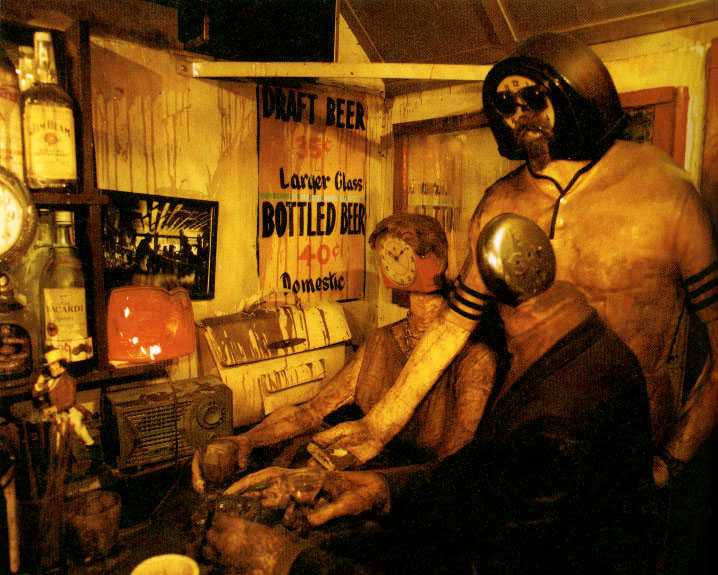
Ed Kienholz was an American artist perhaps best described as a Pop Assemblage and Installation Artist. He assembled objects together to create works, like a diorama in the natural history museum, but manifesting a vulgar or profane vision. In 1965, Kienholz created a tribute to Columbo’s hang-out, West Hollywood dive “Barney’s Beanery.”
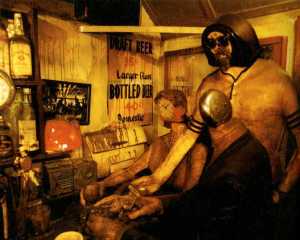
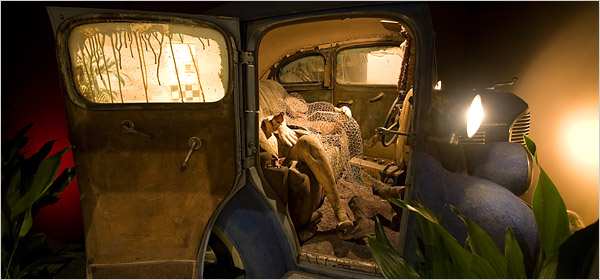
and the following year, Kienholz’s famous tribute to his adolescence, Back Seat Dodge ’38, now installed at the Los Angeles County Museum of Art.
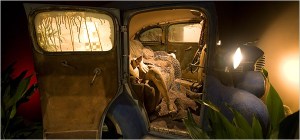
Towards the end of his career, collaborating with his wife, Nancy Reddin Kienholz, his work expressed his apparent contempt for American life. As described in an Art in America article:

The hypocritical excesses of a media-hound like Tammy Bakker clearly propelled the Kienholz rancor into deep space. In All Have Sinned in Room 323 (1992), a female mannequin in an easy chair masturbates beneath a portrait of the smirking evangelist while watching a pathetic Ken and Barbie doll orgy on TV. Incensed by the sanctimonious American patriotism of recent years, the Kienholzes present in My Country Tis of Thee (1991) a quartet of pantsless politician-mannequins who surround a pork barrel in a daisy chain. In this good-old-boy conspiracy, each man has his right hand on his heart while his left, behind him, clutches his neighbor’s penis.

With his not unreasonable disdain for televangelists, he was unable to separate the message of Jesus in Scripture with the charlatans who profited from his name. His last work was a large wall installation 76 J.C.’s Led the Big Charade (1994), which consists of “76 crucifixes whose bases are made from the rusted metal handles of toy wagons. Glued atop the crucifixes are kitsch prints of Jesus, ranging in mood from anguished suffering to smarmy cuteness.” Art in America, June 1995.

Shortly after installing 76 J.C.’s, on June 10, 1994, Kienholz died of a heart attack. In accordance with his instructions, he was buried

. . . in Hope, Idaho, was the artist’s ultimate act of staged outrage. As a tape deck played a loop of Glenn Miller hits, a 1940 Packard was driven by the artist’s wife and collaborator, Nancy Reddin Kienholz, down a ramp and into a freshly dug grave. Kienholz’s body was seated in the passenger seat of the Packard, which was buried with him.

I do not believe that Kienholz’s contempt for the tarnished and mammon-linked public face of contemporary Christianity resulted in divine punishment by heart attack. But his turn to the anti-religious motif at the end of his life is an expression of a spiritual emptiness and despair that is cause for pause at his sudden death.

Damien Hirst, on the other hand, likely has a long career ahead of him at these prices. I have no information or prophetic inclination to believe that he will be struck dead soon. However, he cannot capitalize on satirical religious pieces without eventually boring his rich patrons and falling out of favor. He certainly will have plenty of capital to work with when he does fall out of favor, if he does.

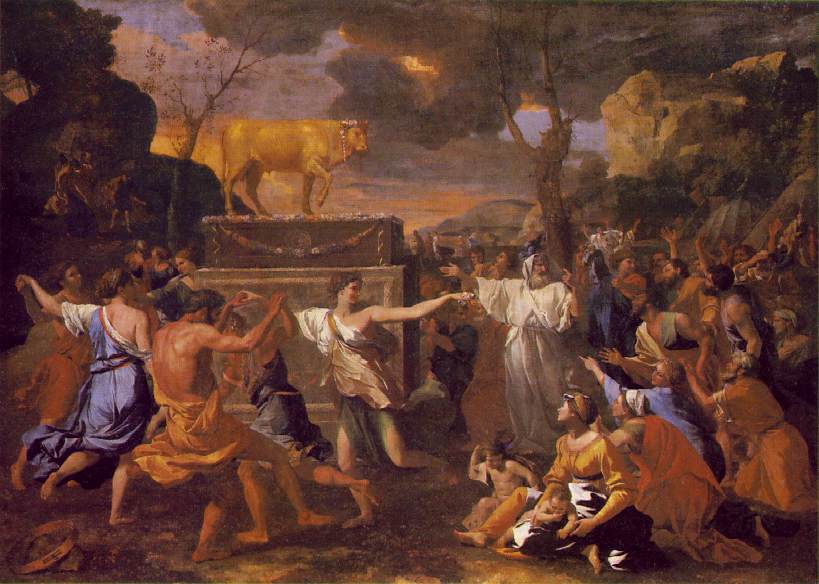
But despite the similar choice of title, can you fairly compare Hirst’s Golden Calf with the Adoration of the Golden Calf, by Nicolas Poussin, hanging in the British National Gallery. Are either of these works beautiful? The battle ensues.
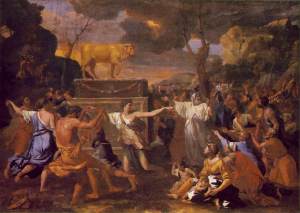

[click on the painting for a full screen view]
Posted by: davidlarkin | July 26, 2008

Who’s a Leftist Creationist?

One of my college classmates referred to me as a “leftist creationist” today in an email on our college class discussion listserv. It struck me as funny to see me characterized as a “leftist” and a “creationist.” My friend is mostly a libertarian, apparently accepts evolution as an explanation, and is clearly far to the right on the political spectrum, such that many, if not a majority of Republicans would be leftists from the island of individuality in his mind. John McCain is the Republican presidential candidate after all.

I am a registered Democrat, a bit to the left of center. I was a registered Republican until I switched to Independent in 1994, and registered as a Democrat for the 2000 election. I favored the invasion of Iraq based on what I was told at the time, e.g., I was worried that Saddam would lob a nuclear weapon into the Saudi oil fields. I do not oppose the Death Penalty and I do oppose abortion. I embrace a capitalist economy, though one reasonably regulated by government because markets are composed of human actors not angels. I accept our democratic republic form of government. I favor a government of the people, not an ideologically determined minimalist government. Although private ownership of property is a fundamental right, there are necessary or agreed upon exceptions. For example, I consider roads and health care to be similar public goods. My cranky right wing classmate believes that health care should remain a private good, rationed by the market. He may draw the line at roads, or maybe even believe that all roads and infrastructure should be privately owned. However, anyone who favors government ownership or regulation of public goods, as we democratically determine to be public goods, is not a leftist as that word has been traditionally used in our political discourse. I will defend the poor and those disadvantaged by birth or luck, as a matter of faith and social conscience. I therefore favor government programs to help them. Using government to help the disadvantaged may make me a leftist to many conservatives, but it is a special area of concern to me, too important to leave to uncertain voluntary action.

So, it seems misleading to label a person with my views a “leftist.” But those who hurl it as an epithet are a small but vocal self-reinforcing insular crowd.

And as a “creationist”, it is true that I believe that God created the universe, but not in a literal Biblical sense, i.e., in seven 24 hour days 5,000 years ago as the fundamentalists who are generally termed “Creationist” believe. Hence it is not really fair to apply that term to me because for many it would put me in that category.

It is not so hard to believe that God created the universe. Science now accepts as fact that the universe had a beginning 13.5 or so billion years ago, and is currently expanding, that is, all matter in the universe is moving away from itself in all directions, space itself is expanding, now attributed to “dark energy,” and this expansion is accelerating by means of that “dark energy” which appears to act as a force of expansion, yet there is no consensus that the energy is a another type of “force” to add to the four we have, i.e., gravity, electromagnetic, strong and weak nuclear forces. The universe could not have created itself, because it would have had to exist and not exist at the same time. At least the principle of non-contradiction has to apply at the beginning. Why do you suppose that physicists and cosmologists are writing books speculating about God, or speculating that there is some multiverse? The multiverse is the materialism faith substitute for God, a theoretical massive collection (ten to the 500th power) of possible universes devised using higher mathematics from unverifiable assumptions, a multiverse that had no beginning and pre-existed our universe, from which our universe began as a bubble from scientifically unverifiable and unobservable multiverse. What if anything separates this from myth or religious belief deserves separate treatment?

It is true that God could use evolution as a means to continue his creation. Many evangelical Christians believe this, especially those who are scientists and science professors. Evolution theory comes in several varieties.

It is non-controversial that within a species, evolution occurs through the mechanism of random mutation and natural selection. Intelligent design proponents, for example, accept this as fact. The controversial issues are first, whether there is any evidence of speciation, new species arising, through this mechanism, and second, whether evolution theory provides any credible explanation for the origin of life. I have a subsequent post on the “origin of life” issue here.

I do not find the evidence offered for speciation through evolutionary processes in the fossil record and in our modern biological laboratory history to be credible, but mostly speculation that requires considerable suspension of reality. For example, how did one-celled creatures with no nuclei (Prokaryotic) evolve into one-celled creatures with nuclei (Eukaryotic), from which humans eventually evolved, as they say? As evolutionist microbiologist Franklin M. Harold wrote in “The Way of the Cell” (a very interesting and accessible book about the cell):

The origin of the eukaryotic cell is arguably the most significant episode in the development of life on this planet, and surely the most baffling one. It is also not a single event, but a protracted process, whose roots reach deep into the early history of cellular life.

Harold, p. 174. As natural history, as speculated by scientists thus far, tells the story, the transformation was not by means of gradualism, i.e., random mutation of DNA, but by means of physical merging of separate creatures.

In his book, Harold then traces the evolution of the eukaryotic cell based on current theoretical speculations, primarily centered around Lynn Margulies who first proposed that mitochondria and chloroblasts came from bacteria that fused with a protkaryotic host. This cell geneology of fusion required separate fusions to come up with the eukaryotic cell bodies, including the nucleus, mitochondria, chloroblasts and other features. Harold writes:

In a phrase coined by F.J.R. Taylor many years ago, the eukaryotic cell appears to be the product of serial endosymbiosis.”

Symbiosis is where “one partner takes up residence in the cytoplasm of the other,” like a merger or fusion. There is no explanation for how this endosymbiosis or fusion of different prokaryotic cells or bacteria actually fused or merged. As Harold writes further,

Endosymbiosis, serial or otherwise, necessarily emerges as the god in the machine. . . .There is a fine air of whimsy about those imaginative tales, with overtones of Rudyard Kipling (“And this, O Best Beloved, is why . . . ). They [current evolutionary theorists] step insouciantly around patches of quicksand, such as what brought about early cellular fusions that are not permitted to contemporary prokaryotes [primitive unicellular organisms lacking true nucleus, cytoskeleton, and organelles], why some genes were discarded and others preserved, and how a consortium of prokaryotes acquired the architectural and functioning complexity of even the simplest eukaryotic cell [unicellular organism with nucleus, cytoskeleton and organelles].

Harold points out that multi-trillions of e-coli bacteria have been studied by microbiologists in the labs over the years without one documented case of symbiosis or fusion of those cells.

As I pointed out in a previous post, the fossil record does not support gradualistic neo-Darwinian evolution theory. So, I am not a believer in materialistic evolutionary theories which purport to explain the evolution of species, whether Darwinian, neo-Darwinian or post-Darwinian emergence theories.

Finally, in addition to speciation, evolution as applied to the origin of life, is mostly silent.

So, to label me a “creationist” is misleading. I find nothing to object to with regard to evolution within a species. I do find the neo-Darwinian explanations for development of species, particularly at the micro-level, to be unacceptable. The evidence for me requires some intervention by God to cause the leaps and miraculous natural history that we observe. While I am not creationist in the sense that one minute there is an ape, and then a human appears behind a tree, as may be the case with the fundamentalist Creationist, I do believe that there is a miraculous (if you call intervention by God in the natural world a “miracle”) intervention in nature, whether by communicating information to the genome, providing the direction of force in the small spaces of the molecule or atom, or by the force of God’s mind in action, etc, to enable the leaps in natural history that are referred to as evolution by materialists and those who accept a mechanistic natural history, even if it is believed that this natural mechanistic natural history was set in motion by God.

Alternatively, you may place your faith in science and believe that science will one day explain everything with a materialistic scientific theory. Even a believer in God may do that, especially Deists.

Franklin Harold, though a firm believer in Darwinian evolution, is cautious in his faith that evolutionary science will provide an explanation for what happened millions of years ago.

There is nothing whatever wrong with disciplined speculation — how else would we know what to look for in the ever growing heap of facts and factoids? But it does warrant the “amiable cynicism” of the Italian maxim quoted by Roger Stanier in one of the first modern essays on cell evolution: se non e vero, e ben trovato. (It may not be true, but it’s well contrived.) and one cannot help suspecting that we are approaching a limit to what can be known, set not by technology but by the nature of this inquiry into the inconceivably remote past.

So, any label purporting to characterize my politics and views on science will have to include a well-crafted definitional paragraph or essay. I have no problem applying simplistic overbroad labels to others, however.
What was it that Emerson said about consistency?

Related Posts
Stephen Jay Gould’s Dissent
Vladimir Nabokov – “Furious” Darwin Doubter
Origins of Life

Posted by: davidlarkin | July 20, 2008

Vladimir Nabokov – “Furious” Darwin Doubter

Although I do not care to have two posts on evolution and Darwinism in a row, today I was reviewing a link here to an intelligent design blog, uncommon descent. Though it is written by some very smart people, I decided that often the tone of the blog was as dismissive, derisive and proud as the public tone of the Darwinist opponents. Though it is hard to be humble in a dispute over important ideas, I deleted it from my blog links.

For me, intelligent design is not “creationist” in the sense that those who believe that God created the heavens and the earth in seven 24-hour days use the term. After review of the evidence, I simply do not believe that in four and one-half billion years, random interactions of particles in fields of force could produce biological nature as we know it without some outside source for the information embedded in DNA, and especially the information necessary for instigating the remarkable abrupt changes in organisms giving rise to what we call species, and for the incredible biological structures and ecological adaptations, both macro and micro, found on this earth. It is too improbable. Among the many conundrums, no one can yet explain how life evolved from living cells without nuclei to living cells with nuclei. It has been proposed that fusion of one living cell with another one-celled organism, which somehow becomes the nucleus of the host is an explanation for the evolutionary leap. However, there is no convincing explanation of how that could happen randomly or otherwise. Generally, the evolution argument avoids real problems like this, relying on the inner-species mutations of pathogenic bacteria to prove the case, for example. Micro-evolution within species is not controversial, yet it does not explain the big leaps, from cell with no nucleus to cell with nucleus, punctuated origin of species, and the genesis of life itself. Hence, I find myself aligned with the intelligent design proponents and other Darwin doubters.

In googling around, I found this discussion of Vladimir Nabokov and his opposition to Darwinian evolution on another ID blog, evolutionnews.org , to which which I added a blog link. I had no idea that Nabokov was at one time a research fellow at Harvard in entomology studying butterflies. According to his biographer, Nabokov was “profoundly indifferent” to religion. Nabokov is another example, like David Berlinski, that finding intelligent design in nature is not limited to theists.

Vladimir Nabokov, “Furious” Darwin Doubter

So was Vladimir Nabokov (1899-1977) secretly a fundamentalist Christian, a mad man, or just plain ignorant? The great novelist (Lolita, Pale Fire, Pnin) was, in his own telling, a “furious” critic of Darwinian theory. He based the judgment not on religion, to which biographer Brian Boyd writes that he was “profoundly indifferent,” but on decades of his scientific study of butterflies, including at Harvard and the American Museum of Natural History. Of course, this was all before the culture-wide sclerosis of Darwinian orthodoxy set in.

As Boyd notes in Vladimir Nabokov: The American Years, “He could not accept that the undirected randomness of natural selection would ever explain the elaborateness of nature’s designs, especially in the most complex cases of mimicry where the design appears to exceed any predator’s powers of apprehension.”

Boyd summarized the artist’s scientific bona fides in an appreciation in Natural History.

For most of the 1940s, he served as de facto curator of lepidoptera at Harvard University’s Museum of Comparative Zoology, and became the authority on the little-studied blue butterflies (Polyommatini) of North and South America. He was also a pioneer in the study of butterflies’ microscopic anatomy, distinguishing otherwise almost identical blues by differences in their genital parts.

Later employed at Harvard as a research fellow in entomology while teaching comp lit at Wellesley, Nabokov published scientific journal articles in The Entomologist, The Bulletin of the Museum of Comparative Zoology, The Lepidopterists’ News, and Psyche: A Journal of Entomology.

According to Boyd, Nabokov wrote “a major article,” subsequently lost, “with ‘furious refutations of “natural selection” and “the struggle for life.”‘” He completed the paper in 1941 but all that survives is a fragment in his memoir, Speak, Memory:

The mysteries of mimicry had a special attraction for me. Its phenomena showed an artistic perfection usually associated with man-wrought things. Consider the imitation of oozing poison by bubblelike macules on a wing (complete with pseudo-refraction) or by glossy yellow knobs on a chrysalis (“Don’t eat me–I have already been squashed, sampled and rejected”). Consider the tricks of an acrobatic caterpillar (of the Lobster Moth) which in infancy looks like bird’s dung, but after molting develops scrabbly hymenopteroid appendages and baroque characteristics, allowing the extraordinary fellow to play two parts at once (like the actor in Oriental shows who becomes a pair of intertwisted wrestlers): that of a writhing larva and that of a big ant seemingly harrowing it. When a certain moth resembles a certain wasp in shape and color, it also walks and moves its antennae in a waspish, unmothlike manner. When a butterfly has to look like a leaf, not only are all the details of a leaf beautifully rendered but markings mimicking grub-bored holes are generously thrown in. “Natural Selection,” in the Darwinian sense, could not explain the miraculous coincidence of imitative aspect and imitative behavior, nor could one appeal to the theory of “the struggle for life” when a protective device was carried to a point of mimetic subtlety, exuberance, and luxury far in excess of a predator’s power of appreciation. I discovered in nature the nonutilitarian delights that I sought in art. Both were a form of magic, both were a game of intricate enchantment and deception.

Sounds like…intelligent design?

That’s what Amardeep Singh thought. He teaches literature at the same university (Lehigh) where Darwin-doubter Michael Behe has been made to feel very unwelcome. Singh comments in a blog entry that his students are startled to read the passage from Speak, Memory. I bet.

My students, I was happy to see, were a little shocked that someone with Nabokov’s way of seeing things would say something that might even remotely be construed as Intelligent Design-ish. And indeed, Darwinian natural selection, as I understand it, does have a fine explanation for the “miraculous coincidence of imitative aspect and imitative behavior”: any mutant variety that doesn’t exhibit a perfect imitation is going to get eaten. And if you have enough random-pattern butterflies getting eaten over time, eventually a strain that has a slightly better design is going to come around and not get eaten.

Comforting! But Singh misses the point of Nabokov’s question. It’s not the perfection of the pattern that needs an explanation. The novelist/lepidopterist asked, if a particular artistic subtlety in that perfection is beyond the ability of a predator to perceive, how did nature select it?

http://www.evolutionnews.org/2008/07/vladimir_nabokov_furious_darwi.html#more

Related Posts
Who’s a Leftist Creationist?
Stephen Jay Gould’s Dissent
Origins of Life
Evolution “Invents” a New Photoreceptor in Humans

Posted by: davidlarkin | July 19, 2008

Stephen Jay Gould’s Dissent

Most of the discussion of Darwinian evolution is between people who don’t know enough about Darwin’s Theory of Evolution. In fact, “Darwinian” evolution is not supported by a preponderance of the evidence, if we were to apply that legal standard. It is actually disproven by a preponderance of the evidence.

Darwinian evolution assumes that evolution is gradual. As it has developed since the advent of microbiology, incremental change in a species occurs genetically with random mutations that gain dominance. Thus, in small steps, a horse becomes a giraffe as the neck gradually lengthens and the species-specific spots occur in the giraffe’s coat, allowing the giraffe to reach high up in the trees for food, and blend into the African landscape. Opposed to this principle of gradualism would be abrupt change and appearance of new species. Darwin rejected abrupt change as follows:

He who believes that some ancient form was transformed suddenly through an internal force or tendency into, for instance, one furnished with wings, will be almost compelled to assume, in opposition to all analogy, that many individuals varied simultaneously. It cannot be denied that such abrupt and great changes of structure are widely different from those which most species apparently have undergone. He will further be compelled to believe that many structures beautifully adapted to all the other parts of the same creature and to the surrounding conditions, have been suddenly produced; and of such complex and wonderful co-adaptations, he will not be able to assign a shadow of an explanation. He will be forced to admit that these great and sudden transformations have left no trace of their action on the embryo. To admit all this is, as it seems to me, to enter into the realms of miracle, and to leave those of science.

Darwin, C. (1872) The Origin of Species. Sixth Edition. The Modern Library, New York.

Science then proceeded to attempt to prove Darwin’s theory and the principle of gradualism by searching the fossil record. If gradualism is a fact, then the fossil record should reveal it. Unfortunately, the fossil record revealed the opposite from gradualism, stasis, followed by abrupt change.

In reaction to the clear failure of the fossil record to support gradualist Darwinism, Stephen Jay Gould with Niles Eldridge, became “heretics” among fellow evolutionists by claiming in 1982 that the Darwinian model was incomplete. They did not believe that the evidence for microevolution and gradualism was sufficient and proposed a macroevolutionary concept of “punctuated equilibrium” where a leap of change occurred seemingly unexplainable at the microlevel, since neither Gould or Eldridge were microbiologists and did not offer a microbiological explanation. Gould and Eldridge proposed this alternative because (1) species appear in the fossil record abruptly, and (2) organisms that make up a species commonly remain virtually unchanged for millions of years before going extinct. They theorized that random mutations in a species generally were not helpful and therefore were not naturally selected. As Gould put in more succintly in a 1977 Natural History article:

A new species can arise when a small segment of the ancestral population is isolated at the periphery of the ancestral range. Large, stable central populations exert a strong homogenizing influence. New and favorable mutations are diluted by the sheer bulk of the population through which they must spread. They may build slowly in frequency, but changing environments usually cancel their selective value long before they reach fixation.

S. J. Gould, 1977. “Evolution’s erratic pace.” Natural History 86 (May): 12-16.

Thus, according to Gould and Eldridge, abrupt genetic change appeared at an isolated environmental “periphery” of a specie’s natural history and existence over space and time such that the stasis recorded in the fossil record was faithful to the general evolutionary history of the species, which was static, and not gradually evolving. This theory caused a fury among fundamentalist Darwinists who clinged then and continue to cling to the gradualist random mutation and natural selection theory.

In Stephen Jay Gould’s 1,000 page opus “The Structure of Evolutionary Theory” (2002), he states very clearly that contrary to Darwin’s evolutionary theory of gradualism of species development, that “stasis and abrupt appearance represent a norm for observed history of most species.” p. 761. (280 pages on punctuated equilibrium theory)

According to Gould, evolutionary biologists have not been forthcoming with the evidentiary record. Darwinian evolution proposes that evolution of new species is gradual due to random mutation. Instead of publicizing findings that the fossil record does not confirm gradualism, he wrote, paleontologists mischaracterized the evidence of stasis as no evidence of anything. Gould writes in a lengthy parenthetical illustrating the profession’s unwillingness to publish the truth as follows:

(To cite a personal incident that engaged this paradox [that the “frequency of stasis in fossil species . . . was unexpected by most evolutionary biologists] upon my consciousness early in my career, John Imbrie served as one of my Ph.D advisors at Columbia University. This distinguished paleoclimatologist began his career as an evolutionary paleontologist. He accepted the canonical equation of evolution with gradualism, but conjectured that our documentary failures had arisen from the subtlety of gradual change,and the consequent need for statistical analysis in a field still dominated by an “old-fashioned” style of verbal description. He schooled himself in quantitative methods and applied this apparatus, then so exciting and novel, to the classic sequence of Devonian brachiopods from the Michigan Basin — where rates of sedimentation had been sufficiently slow and continuous to record any hypothetical gradualism. He studied more than 30 species in this novel and rigorous way — and found that all but one had remained stable throughout the interval, while the single exception exhibited an ambiguous pattern. But Imbrie did not publish a triumphant paper documenting the important phenomenon of stasis. Instead, he just became disappointed at such “negative” results after so much effort. He buried his data in a technical taxonomic monograph that no working biologist would ever encounter (and that made no evolutionary claims at all) — and eventually left the profession for something more “productive.”)

Gould, “The Structure of Evolutionary Theory” p. 760.

The origin of species cannot be “proven” in an experimental sense because it is “history.” Nevertheless, the historical fossil record unequivocally does not provide historical evidence to support Darwinian evolutionary theory. Hence, Gould and Eldridge’s theory of punctuated equilibrium, a non-Darwinian theory of evolution, rejects gradualism and tries to explain abrupt appearance. However, at this time punctuated equilibrium is a macro-evolutionary theory and has no microbiological explanation to make a “preponderance of the evidence” case. (Current Darwinian theory that incorporates microbiological science that did not exist when Darwin lived is generally referred to as “Neo-Darwinism”, though technically, neo-Darwinism was coined in 1895 to limit evolution to natural selection, and exclude any Lamarckian implications of Darwin’s hypothesis of pangenesis, his hypothetical theory of genetics.) There is no explanation for how a changed external environmental requirement, whether on Gould’s “periphery” of species environment or not, could cause significant abrupt micro-biological genetic modification sufficient to adapt former species to the changed environmental circumstances. How could the DNA of a single living cell be sensitive to macro-environmental change? The significance of random mutation to Neo-Darwinism is that it removes any external causal force or condition on the living cell, whether God or nature.

    Related Posts

Who’s a Leftist Creationist?
Vladimir Nabokov – “Furious” Darwin Doubter
Origins of Life

Posted by: davidlarkin | July 16, 2008

Mandatory “Fat Checks” for Japanese Workers

The United States is not alone with rising rates of obesity. According to the latest issue of Foreign Policy, Asia is in the “throes of an obesity epidemic.” Asian governments are responding promptly. For example:

In Japan, where 27 million people suffer from or are at risk of obesity-related conditions, such as diabeties and high blood pressure, healthcare costs are projected to double by 2020. In response, the government recently instituted a policy of mandatory “fat checks” for citizens older than 40. Japanese workers with waistlines greater than 34 inches are to be put on special exercise programs, and companies that fail to meet weight-loss targets will face stiff government fines. In China, where 15 percent of children are overweight, the Ministry of Education last year unveiled a series of specially designed weight-loss dances that students are required to perform in school. And in India, the call-center industry is experienceing a spike in conditions such as diabetes and heart disease due to lack of exercise, leading the health minister to pressure companies to enforce a set of health guidelines for their sedentary workers.

In the U.S., obese people are not a recognized minority protected from discrimination under Title VII. So far, one federal circuit court has held that obesity does not constitute a disability protected by the Americans with Disabilities Act. I cannot imagine Congress passing a law requiring U.S. employers to enforce weight limits, but I can imagine employers firing obese employees for a number of reasons related to risk and expense.

American office employees lackadaisically participating in jumping jacks led by their team leader is sit-com material. The rigid regimen that Asian workers live with at work is culturally a million miles away from the American worker’s experience.

Here Chinese Workers Line Up at the Factory

Chinese workers in chicken factory

Photographs by Edward Burtynsky

Posted by: davidlarkin | July 14, 2008

On Turning 60

Today, I am 60 years old. If I were living in a 19th century Dickens or Eliot novel, I would be a crotchety bent-over character providing comic relief, yelling at my assistant to shake me up in my chair. Actually, I am probably older than those elderly characters. Thank God for modern medicine and nutrition.

Although I do not fear death, I realize I am closer to it. I woke up this morning with first thoughts about what would happen to my family if I died around now. We have life insurance, so remaining in my prone position in bed, I quickly moved on to other age-related thoughts. Eventually, I got out of bed. I don’t know what caused me to do that, I was just out of bed all of a sudden.

Over the past few months, I have looked at this 60th birthday as a significant milestone. All of a sudden, I realize that the things on my life’s back burner — books, films, travel, and other things that I have put off over the years with the idea I would have time later to take up — are all not likely to get done with my remaining life now consciously limited in time. My son is 17, soon to leave to start his own life. My life projects are in transition. I wonder what I will be able to do in the years that follow, with financial limitations from the impact of aging on my ability to work, and from physical limitations to come and already upon me.

Fortunately, I do have my faith in God and salvation in the work of Christ on the cross, provided me by grace. It is a comfort when thoughts of death become more frequent with age. This is heartfelt, not a cliche. Around 1988, when I was living in Carmel, California, I was running for exercise through Pebble Beach which borders Carmel, from the Highway One Gate to the Carmel Gate, when my heart rate suddenly increased to about 190. I could not breath easy and I had great pain in my chest.

I have the low heart rate of a distance runner from my years of running long distance in high school and continuing over the years, including the first Los Angeles Marathon on March 9, 1986. I ran a 3:17 in that race, my first run over 15 miles. I have a picture of me crossing the finish line with my arms outstretched like I won. I had to walk the last mile or so, and there is a turn to the finish line where the grandstands are, so I started running again for the finish, and came around the corner full blast to the cheering of the crowd. The winner had a 2:12:59, passing by the stands one hour and five minutes earlier. There were 10,868 runners in that race. The crowd that sat patiently at the finish line must have been relatives or drinking or both. We started off in a big mass, almost tip toeing after the gun, all of us looking up at the elevated platform where Los Angeles Mayor Tom Bradley stood after starting us. I don’t remember much from the race except when my legs stopped working at about mile 19. I had heard of “hitting the wall” in the marathon, but did not know what it was until it happened, all of my glycogen was gone and my body was out of energy for running.

So, back to my Pebble Beach run, the heart rate of 190 while running through the forest was frighteningly rapid for me; my normal heart rate while running was around 120. My heart beating in a frenzy, and the pain in my chest overwhelming, I sat down on the wooden fence on the bend in the Pebble Beach blacktop road in the forest to die. I thought I was going to die right there. I looked straight out to the forest expecting my visual screen to be replaced by some sort of angelic or heavenly vision. I was very calm and felt at peace.

Instead, my heart rate went back to normal after a few minutes, the pain went away, and I finished my run. I called my friend Frank Stark, an M.D. in Monterey at the time and college classmate. He told me that the heart’s electrical system gets out of whack now and then. Likely, it was paroxysmal atrial tachycardia. I wrote it down and memorized it. I wrote a bad poem about it, “My First PAT.”

The lesson for me was that I am not afraid of death itself because of the gift of faith. I don’t want to die anytime soon because there are things left to learn and to see and do. But it is comforting to have a place to go after death and believe it.

Now, I march on towards age 61, with 60 years and the memories of the joyful and the regretful together behind me. I have a wife and son who I love. I will not have to march alone, though I still tend to walk too fast leaving my family behind scolding me.
————————————————————

For the spiritually-minded or intellectually curious, see also:

My Spiritual Memoir

Posted by: davidlarkin | July 6, 2008

It’s the Economy, Again!

With economic recession closing out the Bush presidency, it is fitting to take a look back at the conclusion of the Clinton presidency. In 2000, Bill Clinton gave his last State of the Union Address. In his autobiography, he sums up as follows:

My last State of the Union address was a joy to deliver. We had more than twenty million new jobs, the lowest unemployment rate and smallest welfare rolls in thirty years, the lowest crime rate in twenty-five years, the lowest poverty rate in twenty years, the smallest federal workforce in forty years, the first back-to-back surpluses in forty-two years, seven years of declining teen pregnancies and a 30 percent increase in adoptions, and 150,000 young people who had served in AmeriCorps. Within a month we would have the longest economic expansion in American history, and by the end of the year we would have three consecutive surpluses for the first time in more than fifty years.

Bill Clinton, My Life, pp. 891-92.

Posted by: davidlarkin | July 1, 2008

Avian Infanticide in Arizona – Grackle Family Life

“Oh, birds of Arizona, who woke me yesterday with your excited chirping, where do you go to die?”

— Billy Collins, “Lying in Bed in the Dark, I Silently Address the Birds of Arizona”

For twelve years, I have been feeding the birds of Arizona in my backyard in Chandler, a suburb of Phoenix. The smaller birds — the sparrows, house finches, mourning, white-winged and inca doves, red-winged blackbirds, brown-headed cowbirds, Abert’s towhees, curve-billed thrashers, and occasional feral parakeets, eat generic wildbird seed and black oil sunflower seeds in the feeders around the house and spread on the dry earth beneath the feeders, grassless from years of incessant pecking. The ubiquitous great-tailed grackles, 15 to 18 inch tall shiny black crow-like males with large square tails and sleek smaller gold-breasted females, eat dried seafood-flavored cat food that I throw across the lawn each morning. I purposely do not use the chicken-flavored cat food to avoid giving them a taste for bird. With their beaks pointing to the sky, the grackles hop across the lawn to dip and soften the crunchy chips in the large clear plastic birthday cake domes from the party store that serve as excellent water bowls. All the birds drink from the bowls, but the grackles, in addition to dipping anything they may try to eat, also use the bowls for bathing in the shade in the 110 degree Arizona heat.

When I first introduced the dried cat food, the grackles took to it immediately. For the first couple of years, I put the cat food on metal trays. The grackles would leap backwards after selecting a chip with a peck. I dropped the metal trays from the feeding program and about two years later, the mourning doves, European starlings, sparrows and Gila woodpeckers had learned to eat the cat food. Now they group by species each morning in a communal feeding frenzy after I leave the yard. Recently, I noticed a grackle taking a cat food chip from the grass and leaping backwards. Was this an old friend back again after ten years feeding elsewhere, still conditioned to leaping from the metal pans? Or maybe a child of a former customer who learned to eat with a leap from their parents?

The grackles have more than a dozen nests in the two large trees in my backyard, especially the evergreen Ficus in which I have counted at least ten nests spread through its leafy branches. The grackles are a community, sharing some duties. For example, if a baby grackle falls from the nest too soon, hiding beneath a bush, all the local grackles, males and females, will dive bomb me, screeching to scare me away, with the mother the most aggressive, of course. I have rescued a few babies, put them in a box open at the top outside overnight out of the reach of the local cats, only to find them gone the next morning, with no sign of any cat attack, apparently rescued by a parent. The fledglings who have left the nest fly with the mother for a few weeks. I see them on the lawn wildly flapping their wings with their mouths wide open waiting for the mother to hop over to feed them some cat food or some water. They fly away together. I have seen a male grackle feed the fledglings on a few occasions.

A few years ago, I went to fill the water bowls in the morning and found four dead baby grackles, all drowned in one bowl. Considering the circumstances of my backyard, only another grackle, a mother I assumed, could have killed them and left them in the bowl, but I could not imagine why they were killed. I emailed the Cornell Lab of Ornithology, but they were unable to provide an explanation. One friend suggested that the mother was depressed, but I could not locate a bird psychologist to question.

Recently, I was exercising on the treadmill, watching Robert Sapolsky, Stanford Professor of Neuroscience and a recipient of the MacArthur Foundation “genius” fellowship, give a Teaching Company lecture on the evolution of behavior. The evolutionary paradigm had changed over the past 50 years, Sapolsky explained. Marlin Perkins’ “Wild Kingdom” had shown in the early 60s how the heroic wildebeest would throw himself into the river, sacrificing himself to the crocodiles so the rest of the herd could cross the river while the crocodiles were distracted by their feast. The wildebeest did this, Perkins told us, for the “good of the species,” an evolutionary communal survival principle. Sapolsky explained that that “old principle” had since been proven false. In fact, he said, the younger stronger wildebeests pushed the weaker older one into the water for their own self-centered evolutionary purpose. The evolutionary principle of individual selection, optimization of the number of copies of an individual’s own genes, Sapolsky said, has replaced the old idea that individuals acted for the good of the species.

With gorillas, lions and some other mammals, a dominant male will have a harem and sire all the offspring of the group, with the other males living in an irrelevant bachelor group. Occasionally, another male will topple the dominant male from his throne. Grimly, the new dominant one will then kill as many infants as he can. This is not a Machiavellian political move, but a matter of individual selection: when the infant dies, the mother ceases nursing and soon ovulates. The new dominant male can then produce offspring with copies of his genes.

One thing I know about the great-tailed grackle from prior research is that, like gorillas, the dominant male grackle has a harem. While listening to Sapolsky’s evolutionary explanation of mammalian infanticide, it dawned on me that what I had likely seen in my backyard was the work of a new dominant male grackle committing infanticide, drowning four baby grackles in order to make a quicker start at producing copies of his genes. I do not know whether the hormonal impact on a mother grackle of the baby’s death is the same or similar to the impact on the nursing gorilla female, but obviously, the mother grackle will have more time to devote to the reproduction rites without the duties of feeding and caring for her babies. Research shows that there is avian infanticide, and although uncommon, most avian infanticide committed by males is directed at eggs, with a record of infanticide directed at fledglings occurring in a couple of species. With the help of google, I found in an obscure book entirely devoted to avian infanticide, one anecdotal account of infanticide by a male Tristam’s grackle, a species found only in the Arabian peninsula.

Answering Billy Collins’ poetic question — Where do Arizona birds go to die? — may be unpoetic, but now and then, infanticide aside, one of my Arizona birds randomly dies in my back yard in no particular place.

HERE IS A BABY GRACKLE REHABILITATED AND RAISED TO SURVIVE:

Posted by: davidlarkin | June 29, 2008

Music Videos and La Vie en Rose

I added some links to favorite music videos on the sidebar [Most of these links have been blocked since this post]. I was at the Newport Folk Festival in 1965 when Bob Dylan shocked the folkies with his electric version of Like A Rolling Stone. I was 16. We were in the very back — a group of high school students from all over the country studying science in an NSF program at Brown. I have included a video of Dylan singing Subterranean Homesick Blues which Dylan has admitted to have borrowed the musical lyrical concept from Chuck Berry’s Too Much Monkey Business (which is also included). Mozart’s Ave Verum Corpus in a cathedral with Leonard Bernstein conducting is breathtaking. Dvorak’s Oh Silver Moon from his opera, Rusalka, sung by Renee Fleming is a favorite of mine. I’m old now and I have gravitated to the peaceful beautiful songs.

The Edith Piaf on the Ed Sullivan Show here Milord I added to my personal links after watching the film “La Vie En Rose.” Watching Edith Piaf sing verifies that Marion Cotillard’s heartbreaking performance as Piaf deserved the Oscar.

Taxes represent the social element of income and wealth, neither of which are possible without the interdependent society and its infrastructure, markets, and people who participate. The amount of the social element is negotiated politically. This is not socialism or communism because the elements of production are privately owned. However, this does recognize that wealth and income cannot be created on a desert island. Creativity and initiative must reap a fair reward, but the social element cannot be ignored.

The best articulation of the principles of this truth I have read is from L.T. Hobhouse, the British journalist, scholar and political theorist, writing in 1911, his words still true today, from his work, “Liberalism and other Writings, Cambridge University Press (1994), from Chapter VIII, “Economic Liberalism”:


———————–

“Wealth, I would contend, has a social as well as a personal basis. Some forms of wealth, such as ground rents in and about cities, are substantially the creation of society, and it is only through the misfeasance of government in times past that such wealth has been allowed to fall into private hands.” p. 90

————————

“The ground problem in economics is not to destroy property, but to restore the social conception of property to its right place under conditions suitable to modern needs. This is not to be done by crude measures of redistribution such as those of which we hear in ancient history. It is to be done by distingushing the social from individual factors in wealth, by bringing the elements of the social wealth into the public coffers, and by holding it at the disposal of society to administer to the prime needs of its members.

“The basis of property is social, and that in two senses. On the one hand, it is the organized force of society that maintains the rights of owners by protecting them against thieves and depredators. In spite of all criticism many people still seem to speak of the rights of property as though they were conferred by Nature or by Providence upon certain fortunate individuals, and as though these individuals had an unlimited right to command the State, as their servant, to secure them by the free use of the machinery of law in the undisturbed enjoyment of their possessions. They forget that without the organized force of society their rights are not worth a week’s purchase. They do not ask themselves where they would be without the judge and the policeman and the settled order which society maintains. The prosperous businessman who thinks that he has made his fortune entirely by self help does not pause to consider what single step he could have taken on the road to his success but for the ordered tranquillity which has made commercial development possible, the security by road, and rail, and sea, the masses of skilled labour, and the sum of intelligence which civilization has placed at his disposal, the very demand for the goods which he produces which the general progress of the world has created, the inventions which he uses as a matter of course and which have been built up by the collective effort of generations of men of science and organizers of industry. If he dug to the foundations of of his fortune he would recognize that, as it is society that maintains and guarantees his possessions, so also it is society which is an indispensable partner in its original creation.

This brings us to the second sense in which property is social. There is a social element in value and a social element in production. In modern industry there is very little that the individual can do by his unaided efforts. Labour is minutely divided; and in proportion as it is divided it is forced to be co-operative. Men produce goods to sell, that the rate of exchange, that is, price, is fixed by relations of demand and supply the rates of which are determined by complex social forces. in the methods of production every man makes use, to the best of his ability, of the whole available means of civilization, of the machinery which the brains of other men have devised, of the human apparatus which is the gift of acquired civilization. Society thus provides conditions or opportunities of which one man will make much better use than another, and the use to which they are put is the individual or personal element in production which is the basis of the personal claim to reward. To maintain and stimulate this personal effort is a necessity of good economic organization . . . an individualism which ignores the social factor in wealth will deplete the national resources, deprive the community of its just share in the fruits of industry and so result in a one-sided and inequitable distribution of wealth. Economic justice is to render what is due not only to each individual but to each function, social or personal, that is engaged in the performance of useful service, and this due is measured by the amount necessary to stimulate and maintain the efficient exercise of that useful function. This equation between function and the sustenance is the true meaning of economic equality.”

p. 91-92

———————–

The true function of taxation is to secure to society the element in wealth that is of social origin, or, more broadly, all that does not owe its origin to the efforts of living individuals. When taxation, based on these principles, is utilized to secure healthy conditions of existence to the mass of the people it is clear that this is no case of robbing Peter to pay Paul. Peter is not robbed. Apart from the tax it is he who would be robbing the State. A tax which enables the State to secure a certain share of social value is not something deducted from that which the taxpayer has an unlimited right to call his own, but rather a repayment of something which was all along due to society.” p. 97

————————

“The distinction that I would claim for economic Liberalism is that it seeks to do justice to the social and individual factors in industry alike, as opposed to an abstract Socialism which emphasizes the one side and an abstract Individualism which leans its whole weight on the other. By keeping to the conception of harmony as our clue we constantly define the rights of the individual in terms of the common good, and think of the common good in terms of the welfare of all the individuals who constitute a society. Thus in economics we avoid the confusion of liberty with competition, and see no virtue in the right of a man to get the better of others. At the same time we are not led to minimize the share of personal initiative, talent, or energy in production, but are free to contend for their claim to adequate recognition.”
p. 101

——————

« Newer Posts

Categories